
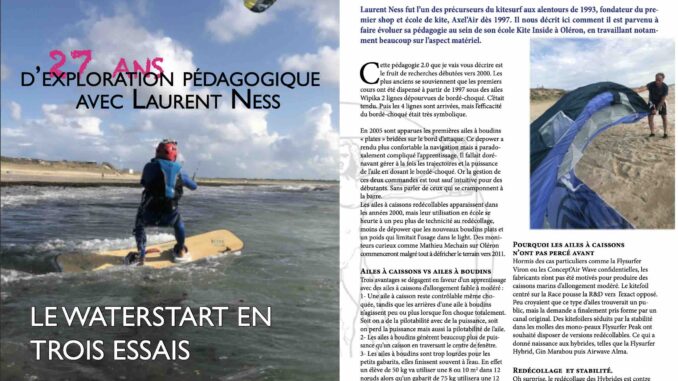
Laurent Ness was one of the pioneers of kitesurfing around 1993, founding the first kitesurfing shop and school ever, Axel’Air, in 1997. Here, he describes how he developed his teaching methods at his Kite Inside school in Oléron, focusing in particular on the equipment aspect. With Laurent Ness in Glassy Vol.1 see the article in its Layout (french)
The Teaching Method 2.0 that I am about to describe is the result of research that began around 2000. Those of us who are older remember that the first lessons were given in 1997 using Wipika 2-line kites without chicken loops. It was tense. Then 4-line kites arrived, but the effectiveness of their depower was minimal at best. In 2005, the first « bow » kites with bridled leading-edge tubes appeared. This depower capability made sailing more comfortable but, paradoxically, made learning more difficult. From then on, it was necessary to manage both the trajectory and the power of the wing at the same time. However, managing these two controls is anything but intuitive for beginners — not to mention those who cling to the bar.
Relaunchable foilkites appeared in the 2000s, but their use in schools was hampered by their relaunch technique, which was slightly more technical, and by less depower than the new flat tubes offered. Curious instructors, such as Mathieu Méchain on Oléron, nevertheless began to break new ground around 2011.
Foilkites vs. inflatable kites
There are three advantages to learning with foilkites of low to moderate aspect ratio:
1- A foilkite remains steerable even when fully sheeted out, whereas the rear lines of an inflatable kite have little or no effect when fully depowered. Either you have controllability with power, or you lose power and steering.
2- Tube kites generate much more power than a foilkite when crossing the center of the window.
3- Tube kites are too heavy for lighter riders and often end up in the water. In fact, a 50 kg student will use an 8 or 10 m² kite in 12 knots, while a 75 kg student will use a 12 m² kite, which is more stable at the edge of the wind window. Relaunching is also more difficult, because lighter riders don’t provide enough resistance.
Why foilkites didn’t catch on before
Apart from special cases such as the Flysurfer Viron or the little-known Concept’Air Wave, manufacturers have not been motivated to produce marine foilkites with moderate aspect ratio. Race-focused kitefoiling is pushing R&D in exactly the opposite direction. Few believed that this type of wing would find an audience, but demand eventually took shape through an unexpected channel. Kitefoilers, attracted by the stability of Flysurfer Peak single-skin wings in light winds, wanted versions that could be relaunched. This gave rise to hybrids such as the Flysurfer Hybrid, the now-discontinued Gin Marabou, and the Airwave Alma.
Relaunching and stability
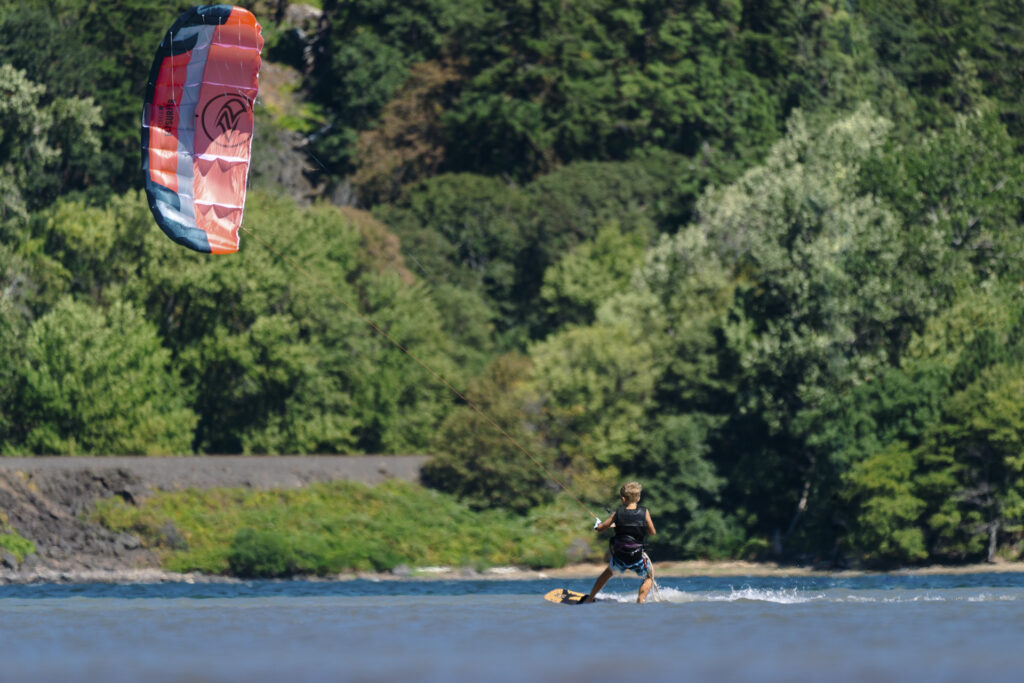
Surprisingly, relaunching hybrids is, contrary to expectations, easier and faster than relaunching an inflatable kite. Between 5 and 10 knots, pull the two rear pre-lines to create a differential between them. Once the wing has pivoted, release them one after the other and it will rise again. In winds above 12–13 knots, especially with sizes below 9.5 m², simply pull one of the rear lines. Stability at the edge of the window is incomparable to that of a tube kite. These wings never front-stall (i.e., tip forward at the zenith)!
Feedbacks after three seasons of teaching
At the end of three seasons, my inflatable wings had never left their bags. With the exception of a 17 m² single-latten for winds below 8/9 knots… whose days would have been numbered if a Hybrid2 had appeared in 15 or 17 m².
“The educational benefits: waterstarting in less than 3 attempts”
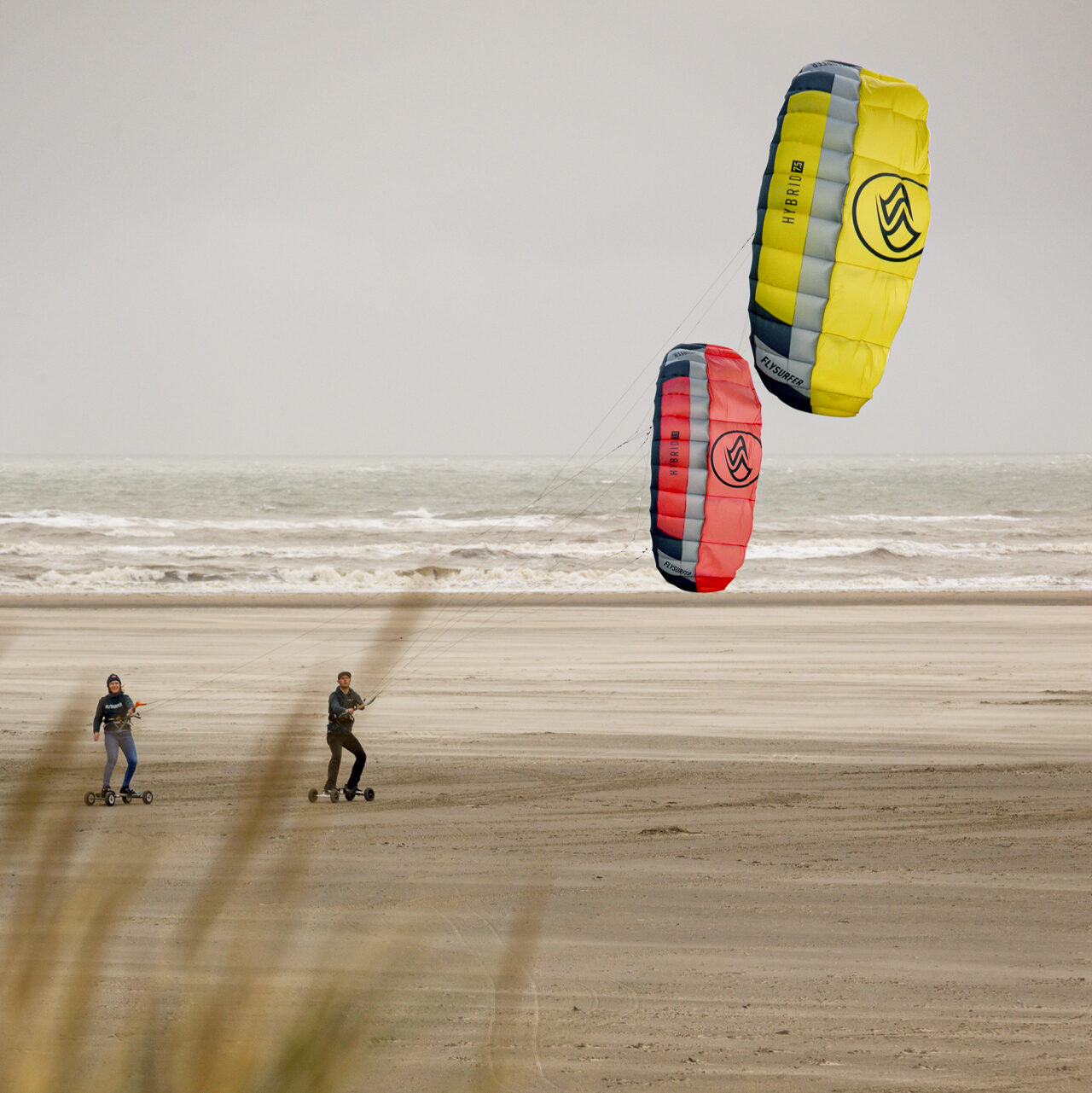
You’ve probably experienced the « tea-bag » effect during your first waterstarts. This situation often arises from a lack of segmentation in learning. Practicing sandstarts on the beach in light winds is particularly beneficial before going into the water, but this exercise poses significant risks with a tube kite. Schools teaching groups of four or more students cannot take on this risk. Even with two students, as in my school, this exercise requires 100% focus on the riders to prevent them from being thrown off. Hybrids do not have this sudden kick when passing through the center of the window, making the exercise much safer. Once the student gets into the water, all they have to do is learn how to put on the straps, since they have already mastered how to steer the kite. As a result, 95% of students succeed at their first waterstart in fewer than three attempts. Of course, another factor also contributes to this result: the board used.
Big Boards: 170 to 230 cm
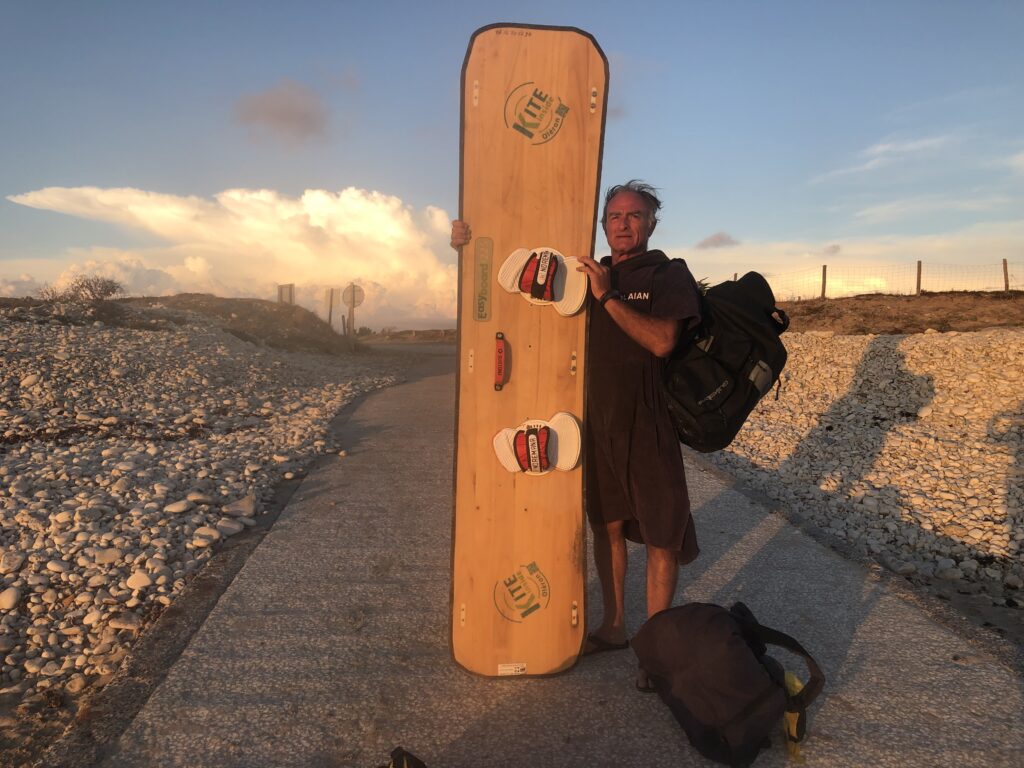
Larger boards also allow for additional instructional segmentation. The waterstart is clearly separated from the subsequent phases, which consist of loading the harness and catching the heelside rail. The student stands up smoothly on the large board without sinking or skidding sideways. Keeping the board on course is very intuitive. The riders can gradually lean into their harness without stalling the board, and their speed will gradually increase without losing control.
Upwind sailing in school from the very first attempts
Learning to kitesurf traditionally involves a phase of struggling to ride upwind, and having to walk back as a result. Sailors don’t have this problem in their discipline, so I looked for ways to eliminate this leeward drift, which wastes time and/or fuel. My research quickly focused on lift, thanks to an increase in the board’s surface area while maintaining an acceptable lift/drag ratio (Cl/Cd). Drag is roughly equivalent to the glide felt on the board. Lift is the force that keeps us on the surface. Tikis and alaias seemed to be good candidates, but the lack of straps and the mandatory jibe make them incompatible with school use. It was therefore necessary to develop larger twintips, capable of offering intuitive edge grip, without roll, and stable on course. After quite a bit of trial and error, the ideal surface area for riders weighing 65 to 90 kg seems to be between 8,000 and 12,000 cm². Compare that to 5,500 cm² on a 145 x 42 cm twintip. Not quite the same, is it?
Fins
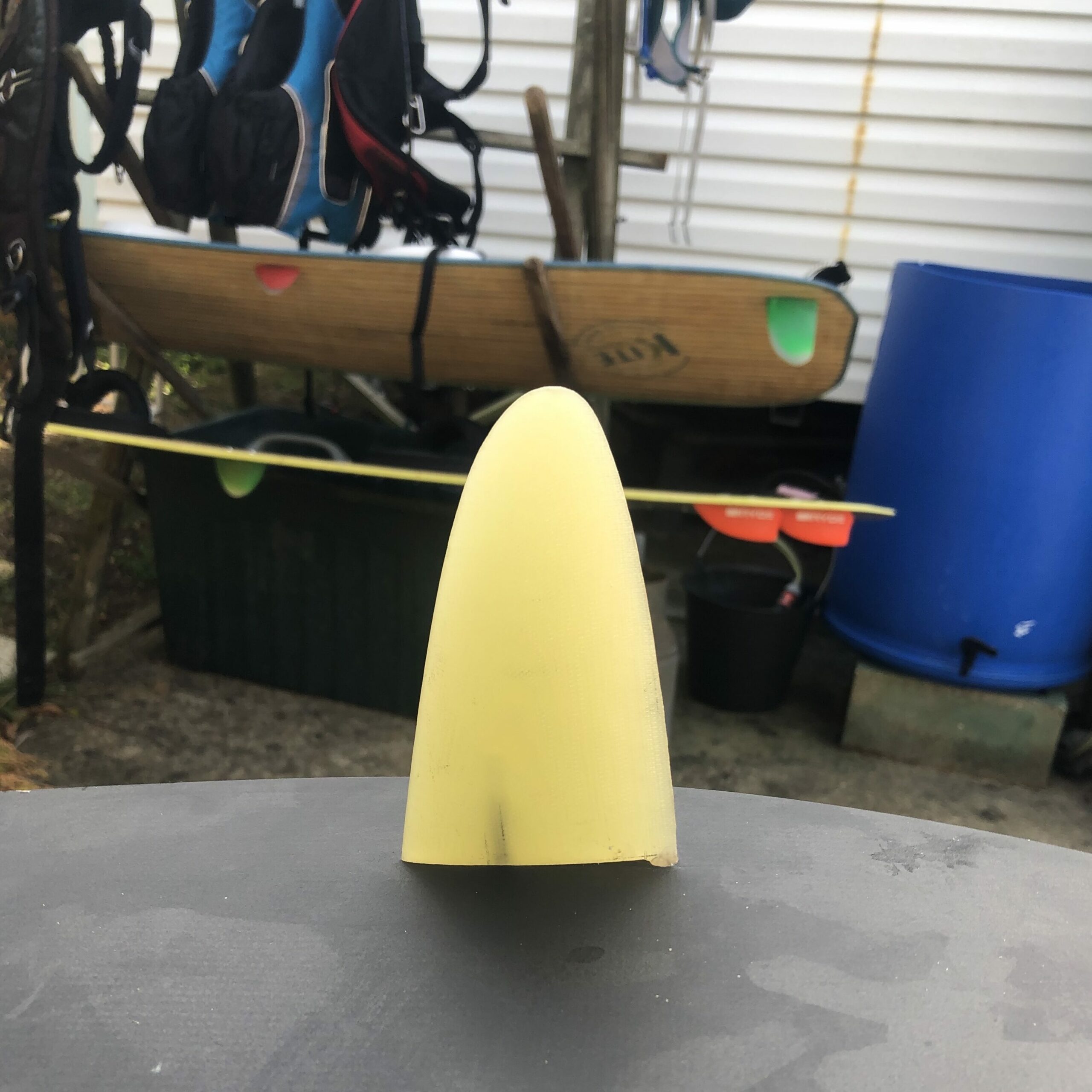
Unfortunately, this increase in board surface area also increases drag and therefore impairs glide. In medium to strong winds, this drawback actually becomes an advantage in a school setting, as the board doesn’t pick up excessive speed. But below 12 knots, good glide is what allows you to quickly build up speed so you can trim your sail. To limit this drag in light winds without reducing the surface area, I looked at the performance of twintip fins, which have a very poor lift/drag ratio (Cl/Cd). So I designed new fins with a high aspect ratio, which created a new constraint: the rearward position of the rear fin created a leverage effect on the leg, which had to be rebalanced by moving the center of thrust forward. This was achieved by adding a symmetrical center fin under the heelside edge. This fin also ensures excellent directional stability, and the toeside fins could be removed following tests showing that the lift/drag performance of the fins is better on the heel edge. The result: 85 kg students who are able to lean into the harness can almost all sail upwind from 10 knots onward. They can sail upwind at school! And from 12 knots onward, all students, regardless of size, can do it. Real-time coaching also leads to a significant reduction in falls, and therefore in downwind drift.
Light wind and flat water: double whammy
Taking swell and chop into account is key when learning and teaching. From 10–11 knots, chop makes things harder for lighter riders. Heavier riders can flatten it out a bit, but above 15 knots, the water’s surface quickly becomes too choppy for easy learning. Being able to take advantage of winds below 11 knots is particularly valuable, as they generate very little chop. And if chop does form, long twintips are extremely stable and make it much easier to handle than short twintips.
A large twin-tip for school and after?
For those who think large twintips are only useful for the first few days, they’re also excellent boards for light winds. Thanks to their ability to sail upwind even in very light winds, you can get away from the crowds stuck in a narrow corridor because they’re unable to get out themselves. Many former students end up buying them and keeping them for light-wind days, despite the stigma that a large board equals a beginner’s board — and, of course, competition from foils among more advanced riders. This explains why so few second-hand ones are available. A custom board starts at €750, but it’s of better quality and, given its rarity, its resale value will remain attractive. Until these boards achieve the same social acceptance as Tikis, perhaps shop-schools or rental companies will one day consider offering them for rent or lease? (See also our Tiki tutorial in GLASSY Vol.1— Ed.)
Laurent Ness leads the kite school Kite Inside on the island of Oléron, in France
BIG BOARDS:
ADVANTAGES : Ride with less wind / Waterstart / Easier to edge / Controlled turning / Stability in even heavy chop
DISADVANTAGES : No standard models over 170 cm / Bulky and heavy / Not suitable for radical maneuvers / Large boards assimilated to beginners
Recommended sizes by weight
35 to 50 kg : 6,500 / 7,500 cm2
160 x 45 to 170 x 50 cm
Several standard models
50 to 75 kg: 8,000 / 9,000 cm2
195 x 45 cm to 200 x 50 cm
Meet a shaper
75 to 95 kg: 9,000 /10,000 cm2
205 x 50 cm to 210 x 55 cm
Contact a shaper
95 to 120 kg: 11,000 / 12,000 cm2
230 x 57 cm
Contact a shaper

Poster un Commentaire