
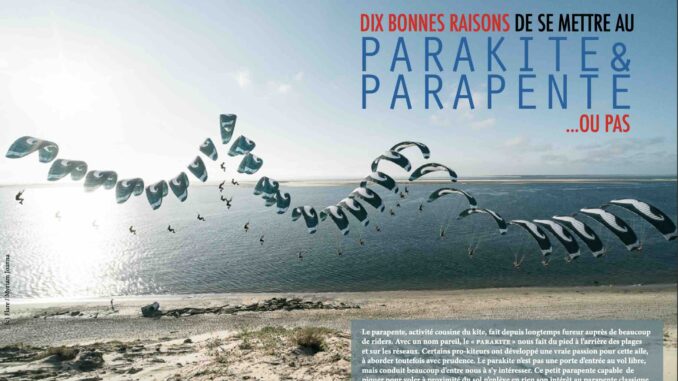
Paragliding, a cousin of kitesurfing, has long appealed to many riders. With such a name, the recent « parakites » are begging to be used on beaches. Most of the pro kitesurfers have developed a real passion for this discipline, though it should be approached with caution. Parakiting isn’t a gateway to free flight, but it does lead many of us to take an interest in it. This type of wing, capable of diving to fly close to the ground, doesn’t diminish the appeal of traditional paragliding, which remains the essential way to learn. Does flying appeal to you? Here are ten good reasons to take the plunge… but also a few reasons to hold off!
By Vincent Chanderot in Glassy Vol1
10 GOOD REASONS TO GO FLY A PARAGLIDER
1. If you love the ability of kites to send big and deliver huge hang time… you’ll adore flying for hours under a paraglider, whether 1 meter or 2000 meters above the ground, with a craft specifically designed for it. If you’re passionate about cliff launches, tow-in flying, and ridge soaring when snowkiting… what are you waiting for?
2. If you know how to fly a kite, you’ll likely have an instinctive knack for ground handling, the fundamental skill of paragliding!
3. If you find joy in kitesurfing through speed, turns, acceleration, glide, gaining altitude, precision, technical skill, piloting, but also the beauty of the landscape and the movement itself… you’ll find all of that with paragliders too! Push the brakes a little harder, and you’ll see it’s not just for retirees!
4. You hate riding in onshore conditions… it’s the best to have fun on the cliffs or dunes and fly wagga! Ten knots is too low for you to kite ? It’s perfect for soaring !
5. You’re feeling down when there’s no wind… Perfect reason to head to the mountains and go flying! Flying a paraglider in the hills asks no wind, so is an incredibly rewarding complement to kitesurfing (when the weather cooperates), and your gear won’t take up much room in your car or garage. Best of all, free flight is the opposite of beach tourism: while the coast is crowded and expensive in summer, you can enjoy the mountains in peace—then return to kitesurfing at the beach once the tourists have gone.
6. If you crave thrills, in paragliding, there’s something for everyone! Enjoy relaxed, contemplative soaring along the coast or playful wagga on the dunes with a mini-wing or parakite. Head into the mountains for hike-and-fly with peaceful evening glides or thermal flights around your local site. Get involved in cross-country adventures exploring breathtaking mountain or lowland landscapes. Get an emotional thrill in aerobatics with G-forces galore and an upside-down feeling. Experiencing fear is not mandatory, but if it’s what you’re looking after, paragliding offers plenty of opportunities!!
7. The higher you climb, the farther you see, the more new peaks and possibilities appear… Climbing to the clouds without an engine, skimming them, circling with vultures, charting a course, covering dozens of kilometers—it’s absolutely incredible!
8. Beneath its sometimes calm appearance lies a true pleasure of gliding, demanding, but one you’ll continue to refine for decades to come. The very best pilots have experience, and there are many of them even after 70. You’re still in the game after 20, which gives us all the hope of being able to perform and progress at any age.
9. Your safety depends on your understanding of your surroundings: you’ll learn a a lot about meteorology and flight mechanics, that will also be useful in windsports. Flying intelligently, senses wide opened, asking yourself where you can and can’t go, is incredibly enriching! The break with daily life is radical; you never think about work in the air.
10. Sometimes it feels like the ocean doesn’t want us. When the water is frozen, when the waves are huge, when the wind direction or the tide isn’t right… It’s not that it’s always warm or that the air mass is always pleasant for flying, but if you do everything right, you can stay dry and have a great time, instead of pushing yourself to the limit in the water.
… OR NOT !
1. The price of your watersports quivers drive you crazy? You’ll love selling your last kidney for a paragliding one! You’ll need a harness and a wing (or even two for soaring in strong winds), plus a reserve parachute and a vario if you plan to gain height in the turbulences. That’s even more gear to accumulate and increase consumption, plus mandatory liability insurance. We’re talking about the same price range as , XXL foilkites, certified to be able to make you fly very high… and in good condition, because this time our lives depend on it! The used market, however, is fairly reliable thanks to inspections that guarantee the equipment’s safety (check out the PG article in Glassy Vol.2 about ageing and buying second hand).
2. Sports that depend on the wind and the weather are a source of immense frustration when conditions aren’t right… you know that already very well. Prepare to suffer, especially with climate change : it looks like things are about to get a little worse.
3. After spending hours preparing your weather forecast, choosing the spot, getting there and launching, organizing a recovery and returning, paragliding, especially in the mountains, can be very time-consuming and demanding. And sometimes, you end up with a 2 minutes flight or a botched attempt!
4. Between kitesurfing and paragliding, assuming you also wingfoil, surf, surfoil, probably a bit of mountain biking and skiing… it can become difficult to manage your work and family aside! Sometimes the right conditions coincide for different activities. More tough choices to make!
5. Seaside soaring spots are fragile and disappearing due to erosion, urbanization, the necessary ban of walking on the dunes and bad behaviours. Consequently, there are often too many people soaring at the last remaining authorized sites. Fortunately, in the mountains, or even in the countryside, there are plenty of other usable spots.
6. Being a good rider doesn’t automatically make you a pilot, much less a good instructor. There are plenty of new things to learn, and this might mean going to a school: they have the equipment suited for beginners and the teaching experience that your generous and enthusiastic friend might not necessarily have. We met many talented big air riders who got a parakite and discovered the 3D on their own, facing great danger.
7. The passive safety of paragliders is very good. They are designed to fly hundreds—or even thousands—of metres above the ground, unlike kites. Nevertheless, the consequences of an incident can be far more serious. Fatal accidents are more common than in watersports. Most accidents occur close to the ground, during take-off or landing, where the surface is not liquid. But flying with 1,000 metres of air beneath your feet also carries obvious risks. Risk management, patient learning and conservative decision-making are even more important than in kitesurfing.
8. It seems easy, and you immediately want much more (and show more)! Be careful not to overestimate your abilities and do something reckless! Especially with the parakite, which allows you to fly very fast in 3D, with a tendency to fly accelerated very close to the ground… which therefore makes it unsuitable for flying novices!
PARA-KITE ??
This concept, which we featured in an article already ten years ago in Stance when it was still in its infancy, is a paraglider designed for ridge soaring and proximity flying. It offers added fun by combining the brake and accelerator on the same control: instead of acting solely on the trailing edge, the control also modifies the angle of attack (like the kite’s trim), allowing for a steep dive and increased lift when exiting turns. The « hands-up » position of the classic paraglider, which offers maximum glide and is the « safety » position adopted in case of emergency, becomes the full-speed position… This implies a slightly different piloting style and, above all, the adoption of new reflexes. Despite a very solid profile, the potential collapse of a parakite will be much more violent, and we clearly see the tendency to fly at much higher speeds in parakites than in paragliders (and at moments when using the foot accelerator wouldn’t even occur to your mind). This is especially true because parakites are used to fly at very low altitudes.
These wings are not designed to handle the turbulence of strong thermals and are therefore less versatile than paragliders. It is not recommended to release the controls, and you cannot close its ears (to descend faster). These wings often have so-called reflex profiles, which are more stable at low angles of attack, but still require active piloting. (See also this article) Manually controlling dives must be done decisively, otherwise this reflex effect will be negated. Ultimately, this equipment being more technically, physically and mentally demanding, you understand why we strongly recommend acquiring good experience in paragliding and then in mini-wings beforehand!

Poster un Commentaire